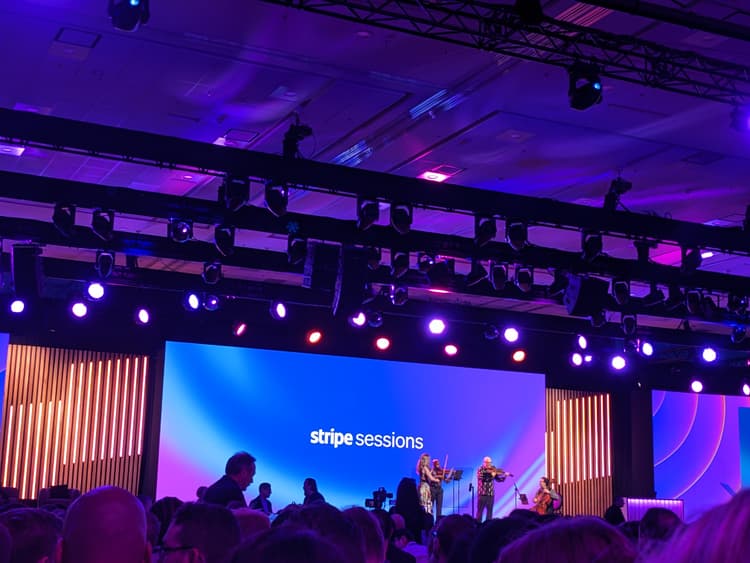
Sessions 2026
I attended Stripe's Session conference this year from April 29–30. My interest in payment gateways dates back to 2015–16, when I attempted to launch a niche e-commerce site focused on sustainability. Since then, through various engineering stints in finance departments, I’ve closely followed the space. I went into the conference curious and pushing myself outside my comfort zone. After a two-hour morning commute, I reached Moscone West by 9:00 AM, ready to see where the payment industry is heading in this "agentic era".
The first day was packed with keynote events and lightning talks, providing a solid overview of Stripe’s newest products and the ecosystem they are building. On the second day, following the morning keynote, I attended the "Build an Agentic Commerce Solution" workshop.
In the workshop, I implemented several concepts introduced on day one:
- Universal Commerce Protocol (UCP): A standard communication format between Agents (ChatGPT, Gemini, Claude, etc.), Merchants (third-party services like Nordstrom, REI, GAP, etc.), and Payment Processors (Stripe, PayPal, etc).
- Shared Payment Tokens (SPT): A method for secure communication between a user's Stripe profile and merchants via an agent.
- Radar: Stripe’s specialized tool for detecting unusual financial transaction activity.
This is the architecture of the agentic commerce solution we built:
┌──────────────┐     ┌──────────────────────┐     ┌─────────────────┐
│   Frontend   │────►│   Agent Service      │────►│ Merchant Service│
│              │◄────│                      │◄────│                 │
└──────────────┘     └──────────┬───────────┘     └─────────────────┘
                               │
                     ┌─────────┴─────────┐
                     │                   │
              ┌──────▼──────┐    ┌───────▼───────┐
              │ AI Service  │    │ Stripe Proxy  │
              │ (LLM)       │    │ (Lambda)      │
              └─────────────┘    └───────────────┘
From the workshop I learned:
- How agents communicate with merchant services using defined JSON schema. For example a merchant responds to agent's request for a product, book -- The Hobbit, in this format:
{
"id": "BOOK-001",
"type": "Fiction",
"author": "JRR Tolkiens",
"title": "The Hobbit",
"price": 16,
"currency": "USD",
"description": "A whimsical tour",
"category": "Fantasy Fiction",
"stock": 25,
"selectors": {
    "genre": ["Fantasy Fiction", "Epic"],
    "themes": ["Philosophical"],
    "mood": ["Immersive"],
    "length": "Medium",
    "difficulty": "Moderate"
    }
}
will have a defined JSON schema like this:
  "name": "product_description",
  "description": "Product Description",
  "type": "object",
  "required": ["id", "type", "author", "title","price","currency", "description", "category", "stock", "selectors"
  ],
  "properties": {
    "id": {
      "type": "string"
    },
    "type": {
      "type": "string"
    },
    "author": {
      "type": "string"
    },
    "title": {
      "type": "string"
    },
    "price": {
      "type": "integer"
    },
    "currency": {
      "type": "string"
    },
    "description": {
      "type": "string"
    },
    "category": {
      "type": "string"
    },
    "stock": {
      "type": "integer"
    },
    "selectors": {
      "type": "object",
      "required": ["genre", "themes", "mood", "length", "difficulty"],
      "properties": {
        "genre": {
          "type": "array",
          "items": { "type": "string" }
        },
        "themes": {
          "type": "array",
          "items": { "type": "string" }
        },
        "mood": {
          "type": "array",
          "items": { "type": "string" }
        },
        "length": {
          "type": "string"
        },
        "difficulty": {
          "type": "string"
        }
      }
    }
  }
}
UCP establishes these standards to ensure consistent, predictable responses across merchants.
- The need for various security verifications in different steps of communication between services (machines), validation of successful transactions to be communicated using a webhook (one-way data sharing triggered by events) -- Stripe decrementing merchant's stock on a successful sale.
Ultimately, I see agentic solutions as natural language-driven automation. This level of automation between disparate services requires a standardized communication "language", and Stripe is positioning itself to be that standard for the agentic era. As the saying goes, we are standing on the shoulders of giants—leveraging years of progress in Networking, Natural Language Processing (NLP), and Cryptography to make machine-to-machine commerce secure and seamless.
I learned a lot! A huge shout out to Liam O'Neil for leading the workshop and to everyone involved in making this event happen.
This is a starter kit.